Meeting rooms in offices: what is the cause and how to solve the problem with modern property management
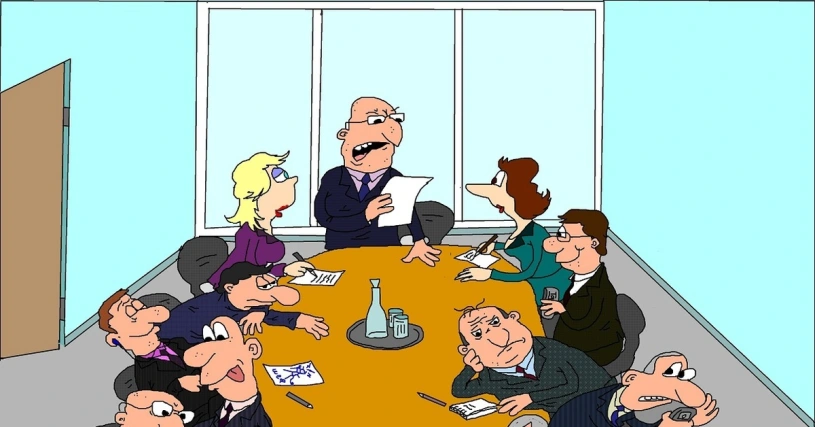
According to the results of numerous surveys of office workers, the lack of "negotiations" is one of the first places among the main organizational problems. And this problem is equally relevant for both large companies and small offices. What can be the way out of this situation, especially when it is impossible to move? There are three ways out of the situation: creativity, organization of "flexible" spaces and optimization of planning.
Types of meeting rooms
There are three main conventional groups of office meeting rooms:
- Corporate (back office). Designed for meetings within the company. This format allows you to use a fairly democratic organization of the space, which can also serve as a rest room for office workers.
- General (front office). Here both negotiations with clients and working meetings can take place.
- Closed. As a rule, such a space is combined with the office of the head. In this case, small sizes are quite appropriate, since we are talking about meetings with a narrow circle of persons. In addition, the office may be very small isolated areas designed for private communication of several people. But, of course, to conduct full-fledged presentations, especially with multimedia equipment, in such rooms is impossible.
Features of planning
The ideal situation for independent planning of office space is the selection of a new office space. However, it is very rare for a company to be able to maintain an office "with a reserve" in terms of space and the number of additional rooms. After all, over time the staff will grow, and accordingly there will be a shortage of rooms for negotiations.
In addition, such "economy" can have a very negative impact on the work of the office: to find a free room, firstly, takes extra time, and secondly, the situation itself in the eyes of the client will look very unattractive. The overall efficiency of work also suffers.
According to designers, the share of "quiet" rooms in open-space should be about 10-15%. And in order to provide the necessary reserve for the future, it is necessary to lay down exactly this proportion at the stage of finishing.
Using flexible solutions
One of the most reasonable solutions is to design several compact meeting rooms that are separated by mobile partitions. Such a solution will make it possible to combine these areas into one office when the need arises.
To organize such small rooms, you can use sound-absorbing materials. They will not disturb the general interior of the open-space space and will be a good solution for short negotiations. In addition, here you can organize a workspace for working in silence.
Designing multifunctional spaces is one of the most reasonable solutions for offices. For example, if you use transformable furniture to organize a lounge area, you can provide the office with enough meeting rooms.
Creative solutions
To optimize the use of meeting rooms to some extent, tools such as electronic booking and key logging are very useful. But in practice, it is impossible to predict the exact time of negotiations - they often drag on. That's why there are a number of creative solutions:
- A time limit for booking a room. For example, a maximum of 45 minutes.
- Participation of a facilitator in the negotiations. This is an employee whose task is to ensure the agenda and regulations of the negotiation process.
- Minimalism in the interior. When nothing distracts from the essence of the meeting, negotiations tend to be faster and more productive.
- Strange as it may seem: refusal of comfortable soft armchairs in favor of more rigid office chairs. The lack of comfort contributes to faster negotiations.
- And a very creative move - a complete rejection of chairs. In such an environment, it is unlikely that anyone will be able to delay a meeting.
All at once or a compromise?
The main factor influencing the design of a meeting room is its purpose. For example, a shared or corporate room will be quite different from the private meeting area used by the CEO. However, regardless of this, as a rule, there are tables, chairs, cabinets for documents and clothes, sometimes provided for the presence of a bar, toys, etc.
As for equipment, it is obligatory to have:
- Telephone.
- A projector with a screen or a computer with monitors
- A marker board.
- Access to Wi-Fi.
- MFP.
If we are talking about master classes, seminars, presentations, this set is mandatory. When the negotiations provide for the participation of no more than 2-3 people, then most often the equipment is limited to a marker board and a laptop. The main thing is to follow common sense and keep a compromise between the company's technical capabilities and desires.